Charente and Charente-Maritime are two departments with a wealth of culinary delights! Whether you are a fan of local produce or seafood, the Charentes will surprise you!
Specialities in Charente, the land in the spotlight.
- Pineau des Charentes: This is a fortified wine made by mixing grape must (unfermented grape juice) and young cognac. It can be white, rosé or red, with fruity and sweet notes. Legend has it that a winegrower accidentally poured grape must into a barrel containing cognac. Years later, he discovered an exceptionally sweet and aromatic beverage… But officially, Pineau des Charentes has been produced since the 16th century. Much less impressive when you put it like that! This beverage is very popular as an aperitif and goes well with sweet and savoury dishes, cheeses and desserts. It has been AOC (Appellation d’Origine Contrôlée) certified since 1945 and remains a source of pride for our beautiful Charente region!
- Cognac: You will love discovering this wine spirit aged in oak barrels, produced exclusively in the Charente region! There are several classifications according to the age of ageing (VS, VSOP, XO, XXO). Don’t panic, we’ll explain! The VS (Very Special) designation corresponds to a cognac whose youngest brandy is at least 2 years old. The VSOP (Very Superior Old Pale) designation corresponds to a cognac whose youngest brandy is at least 4 years old. The XO (Extra Old) designation corresponds to a cognac whose youngest brandy is at least 10 years old. And finally, the designation XXO (Extra Extra Old) refers to a cognac whose youngest eau-de-vie is at least… 3 years old? No! 7 years old? Of course not… 15 years old? Yes! That’s the right answer! It’s important to know that cognac emerged in the 16th century thanks to the Dutch, who were looking for a way to preserve wine for transport. They distilled it, and the double distillation process was perfected by local producers, giving rise to cognac as we know it today. It is renowned worldwide, with over 90% exported, and is appreciated by spirits lovers. It can be enjoyed neat, in cocktails or used in cooking, whichever you prefer!
- Grillon charentais: This is a type of compact rillettes made with pork (often belly and shoulder), slowly confit with salt, pepper and sometimes garlic or cognac. Unlike traditional rillettes, grillon charentais is less stringy and more compact! A true peasant speciality, grillon was prepared when pigs were slaughtered on Charente farms. Preserving it in fat meant it could be enjoyed all year round. Today, it is an essential accompaniment to country bread and a staple of aperitifs and local markets. And it’s easy to see why!
- Charente-style snails: What we call ‘cagouilles’ in local dialect are actually nothing more than simple snails! They are simmered in a sauce made from white wine, garlic, parsley, bacon and sometimes tomatoes or bread to thicken the sauce. Charente is one of the regions of France where snails are most commonly eaten. Traditionally, families would collect them in the fields after rain and cook them for festive meals. It is obviously a rustic and convivial dish that is very popular at local festivals and is an integral part of Charente’s culinary heritage. So hands off my cagouille!
- Cornuelles: These are small triangular biscuits flavoured with aniseed or orange blossom, with a hole in the centre. Nothing could be simpler to describe! They can be plain or filled with whipped cream. Yum. Paired with a A spring tradition in Charente, cornuelles are often eaten on Palm Sunday (13 April 2025). The hole in the centre symbolises the host or the Holy Trinity. Originally, they were bought outside churches and offered as a sign of sharing. They are still very common in Charente bakeries during religious festivals, and some artisans are modernising them with increasingly indulgent variations!
Specialities in Charente Maritime, the tasty ocean
- Bouchot mussels: These mussels are farmed on wooden stakes (bouchots) planted in the foreshore, where they grow sheltered from marine predators. They are small, plump and, above all, very tasty. Mussel farming on mussel beds dates back to the 13th century and is said to have been introduced to France by an Irish shipwreck survivor, Patrick Walton. who discovered this technique by observing piles covered in mussels. Patrick is very observant! This is a flagship product of Charente-Maritime, used in particular for ‘mouclade charentaise’ (mussels with curry and cream). They benefit from a PDO. (Protected Designation of Origin) ‘Moules de bouchot’ to guarantee their quality!

- Marennes-Oléron imperial prawns: These prawns, with their subtle, slightly sweet taste, are farmed in salt marshes (the same basins as oysters). They have firm flesh and a naturally slightly green colour due to the algae they consume. They were imported from Asia in the 19th century and have acclimatised well to the Charente marshes, as you can see! After nearly disappearing, they were brought back by local producers keen to preserve this tradition. It is a A rare, high-end product that is highly prized by gourmets and often served grilled, as carpaccio or simply pan-fried with butter and garlic – it does the job perfectly!
- Surgères butter: It is renowned for its creaminess and nutty flavour. It is made from matured cream, which gives it a melt-in-the-mouth texture and rich aroma. Surgères has been a dairy-producing region since the 19th century. Thanks to the local cooperative, Surgères butter quickly became a benchmark product, particularly appreciated by pastry chefs. This butter is renowned throughout France and is used in cooking as well as in pastries and cakes. It has held the AOC (Appellation d’Origine Contrôlée) and then the AOP (Appellation d’Origine Protégée) ‘Beurre Charentes-Poitou’ labels for 30 years, guaranteeing its authenticity and high quality to the whole world! (Are we exaggerating?)
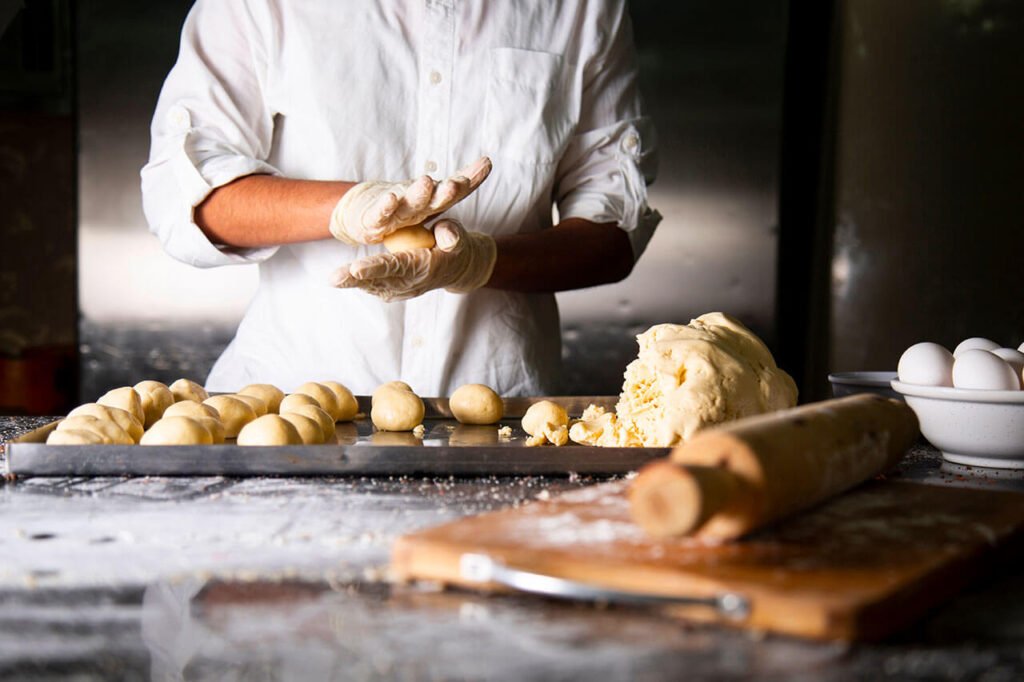
- Millasse charentais: This is a traditional flan made with milk, flour, sugar and eggs. It resembles a far breton, but is lighter, flavoured with vanilla or angelica and, of course, much tastier. It is a typical peasant dessert from Charente-Maritime, prepared on farms using locally available ingredients. It was often served to large families after meals. This dessert remains relatively unknown outside the region, but is still prepared by some artisan bakeries and during local festivals.
- Jonchée: This is a fresh cheese, usually made from cow’s milk (sometimes goat’s milk), presented on rushes for draining and flavouring. A rush is a plant with a straight stem. To drain the cheese, these stems are placed side by side to form a kind of mat. Jonchée is often eaten sweetened with honey, sugar or orange blossom water. This speciality dates back to the Middle Ages and was produced in the Charente marshes, where natural rushes were used for moulding and preservation, giving it a slightly herbaceous taste. It remains a typical, artisanal product, mainly found in local markets. It is a light and refreshing dessert, perfect for summer!