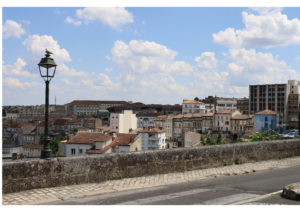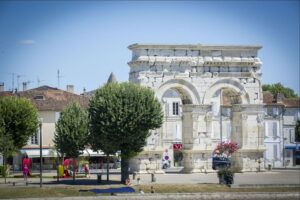
Located 20 minutes from Fontdouce Adventure Park, the town of Cognac is sure to impress you! But before you go, here is a brief history of the town and how it has evolved over the centuries…
History of the city through the ages
The rise of the town of Cognac began mainly between the 11th and 13th centuries thanks to the Charente River, with the development of the wine trade adding to that of salt.
Then, around the 15th century, the Dutch came to stock up on goods from the Cognac and Angoulême regions, giving the town a new lease of life. At the time, the city had three districts: the Port Saunier district, the Château district and the Saint-Léger district. During the Hundred Years’ War from 1337 to 1453, the city was alternately under French and English rule.
Once the war ended in the 15th century, the town prospered and became home to the royal family, with Charles d’Orléans and Louise de Savoie deciding to make Cognac an intellectual and artistic centre. Later, they gave birth to the future Marguerite de Navarre in Angoulême on 11 April 1492 (also known as Marguerite d’Angoulême) and the future King of France, François I, in Cognac on 12 September 1494. The town was thus embellished and buildings were rebuilt, but little by little, the town became impoverished as a result of the Wars of Religion, Cognac being predominantly Protestant.
It was during the Catholic Counter-Reformation in the 17th century that religious buildings and mansions began to appear in Cognac: this marked the beginning of the brandy trade. As a result, in the 19th century, the town expanded and was able to accommodate many more inhabitants, growing from 6,000 to 18,000 in less than a century. However, green spaces were still preserved, notably thanks to gardens and parks that can still be found today.
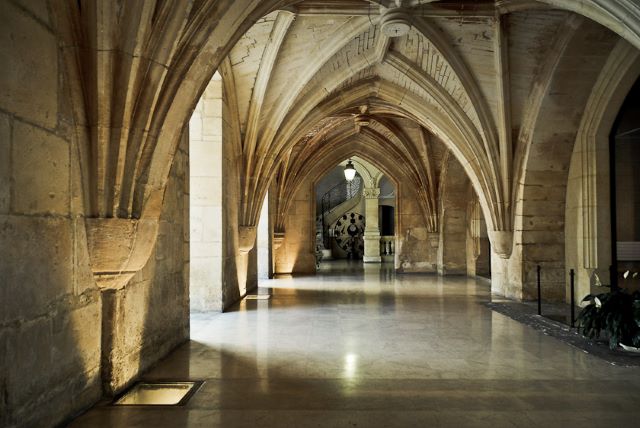
What we find today
Today, the remains that can be seen from this period are primarily the old medieval fortified walls, notably the gate and towers of the Old Port of Saint-Jacques de Cognac. Mostly Catholic religious buildings are still standing, such as the Récollets convent and Saint-Léger Church.
Nowadays, the town of Cognac is mainly focused on its brandy, and most of the jobs created are related to this activity, starting with trading, distilling, cooperage, glassmaking, etc. Many cognac houses have been established, and the cellars are one of the most popular parts of the tours.
However, Cognac is a town steeped in tradition and expertise, which is clearly evident in its various museums, starting with the Cognac Arts Museum, which traces the history of viticulture, oenology and distillation, right through to bottle packaging. The Museum of Art and History, meanwhile, displays collections belonging to wine-trading families, including paintings, sculptures, archaeological artefacts and other documents related to the cognac industry.
When you visit Cognac, you will discover a welcoming town steeped in history and culture. No visit to the town would be complete without visiting a Cognac house such as Hennessy, Martell or Remy Martin, or the public gardens with the town hall at their centre. If you visit Cognac, you will inevitably pass by Place François I with its large statue of the king. If you fancy a trip along the Charente, head to the quayside where the modern barge ‘La Demoiselle’ awaits you for a guided tour lasting around two hours, during which you can discover the town’s architecture from the river. And for thrill seekers, a detour to the Fontdouce Adventure Park with its tree-top adventure courses offers a fun and sporting escape in the Saintonge region, 15km from Cognac.